What Size Solar System Do I Need in Albany?
A plain-English guide to sizing solar panels, inverters and batteries for homes across Albany and the Great Southern, written by a local SAA-accredited team that has been designing systems for our southern coast climate since 2010.
- Local Albany sun-hour figures
- 2026 Western Power & Synergy rules
- Free sizing check from our team
The Quick Answer
Most Albany homes suit a 6.6kW to 10kW solar system. A 1–2 person household using around 12kWh a day is usually well served by 6.6kW of panels on a 5kW inverter. Families using 20kWh or more a day, or anyone adding a battery, EV charger or heat pump, typically need 10kW to 13kW. The right size depends on your electricity bill, when you use power, your roof, and the grid rules for your connection, not just the size of your house.
- ~4kWhaverage daily output per 1kW of panels in Albany across the year
- ~2.5kWhwhat that same 1kW makes on a typical June or July day
- 133%maximum panel-to-inverter ratio to keep your full STC rebate
- 5kWlargest solar inverter eligible for Synergy’s DEBS feed-in credits
How to Size Your Solar System in 5 Steps
This is the same process our designers follow at the kitchen table. Grab your last Synergy bill and you can work through it in about ten minutes.
Find your daily usage
Look for “average daily usage” on your Synergy bill, measured in kWh. Check a summer and a winter bill, because Albany homes with electric heating often use far more from May to September. If you can, log in to My Account to see your usage by time of day.
Work out when you use it
Solar only saves you money on power you use while the sun is up (or store in a battery). Synergy’s buyback rate for exported solar is a small fraction of what you pay for grid power, so a home that runs the dishwasher, pool pump and hot water in the middle of the day gets far more value from the same system.
Apply Albany’s sun hours
As a starting point, divide your daily usage by 4. A home using 22kWh a day lands at about 5.5kW, which in practice means a 6.6kW system. Then allow for winter: our shorter, cloudier days off the Southern Ocean mean output roughly halves in June compared with January.
Check your roof
Each modern panel is roughly 2m² and 440–475W, so a 6.6kW system needs around 14–15 panels. North-facing roofs perform best, but east/west splits work well for morning and afternoon usage. Watch for shading from peppermint trees, chimneys and neighbouring two-storey homes.
Match it to the grid rules
Your inverter size is shaped by Western Power’s connection rules and whether you want Synergy feed-in credits. A 5kW inverter keeps you eligible for DEBS. Going larger can make sense with a battery, but you give up export credits. We explain the trade-off in the section below.
Rather we do the maths?
Send us a photo of your bill and your address. We will check your roof on satellite imagery and come back with a recommended size, free.
Solar System Size Guide for Albany Homes
Use this table as a starting point. Output figures are approximate averages for a well-oriented, unshaded roof in the Albany area.
| Household | Typical daily use | Suggested system | Approx. daily output (winter / year avg / summer) |
|---|---|---|---|
| 1–2 people, gas or heat-pump hot water | 8–14kWh | 6.6kW panels · 5kW inverter | 16 / 26 / 36kWh |
| 3–4 people, daytime occupancy | 15–22kWh | 6.6–8kW panels · 5kW inverter | 16–20 / 26–32 / 36–44kWh |
| 4–5 people, reverse-cycle heating, pool | 20–30kWh | 10kW panels · hybrid inverter + battery | 25 / 40 / 55kWh |
| All-electric home with EV | 30kWh+ | 13kW+ · battery · often three-phase | 33 / 52 / 70kWh+ |
| Farm, shed or small business | Varies | Custom design | Modelled on your load profile |
The rule of thumb
System size (kW) ≈ daily usage (kWh) ÷ 4
Then round up to the nearest standard size and add capacity for anything you plan to add in the next five years, such as a battery, EV or heat pump. It is almost always cheaper to install the right size once than to add panels later.
Want exact numbers? Try our solar calculators or browse our solar packages with current Albany pricing.
Why Sizing Solar in Albany Is Different to Perth
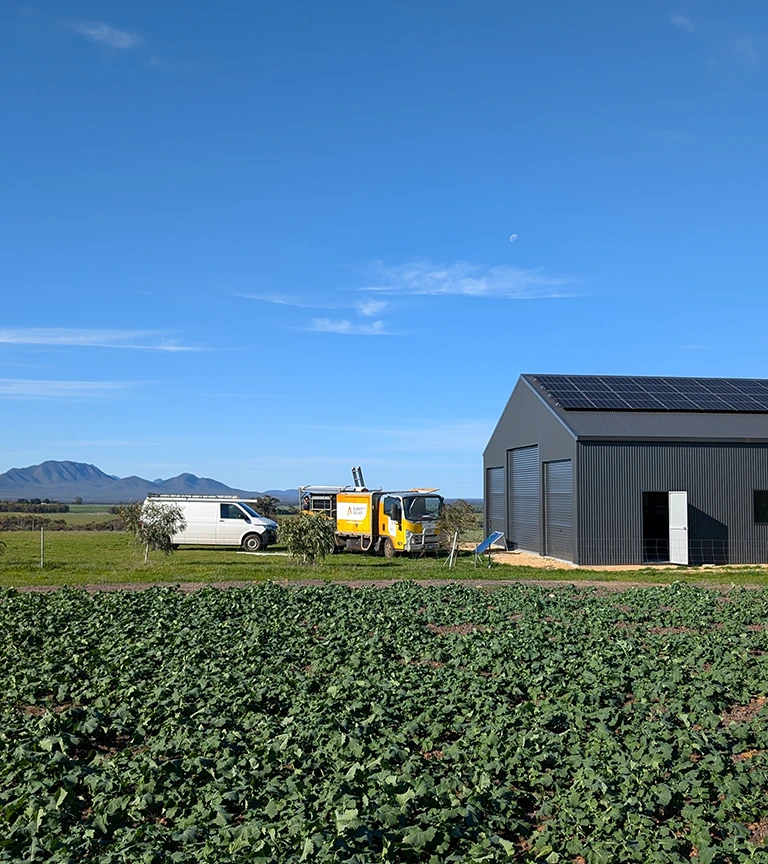
Most online solar calculators are built around Perth’s weather. Albany sits on the south coast with a milder, wetter climate, and that changes the maths.
- Lower winter output. Cloud and rain rolling in off the Southern Ocean mean June and July production is noticeably lower than in Perth. If winter bills are your pain point, size for winter rather than the annual average.
- Cooler panels, better efficiency. Solar panels lose efficiency in heat. Albany’s mild summers mean panels run cooler and often outperform their Perth equivalents from December to March.
- Coastal conditions. Homes near Middleton Beach, Emu Point, Goode Beach and Little Grove need corrosion-resistant mounting and components rated for strong coastal winds.
- Winter heating loads. Many Great Southern homes run reverse-cycle air conditioning through winter, which pushes evening usage up. This is where a battery earns its keep.
Inverter Size, Feed-In Credits and the 2026 WA Grid Rules
Albany is connected to Western Power’s South West Interconnected System (SWIS), and most homes buy power from Synergy. Both set rules that directly affect how big your system can be and what it earns.
Option A: 5kW inverter, keep feed-in credits
Synergy’s Distributed Energy Buyback Scheme (DEBS) only credits exports from systems with a solar inverter capacity of 5kW or less. Pairing a 5kW inverter with up to 6.65kW of panels is the classic WA setup and suits most homes without a battery.
Option B Bigger inverter, use it or store it
Larger inverters are allowed, but you give up DEBS credits for exports. This works best when you pair more panels with a battery and use most of your solar at home. For many Albany families adding a battery, this is now the better long-term option.
New in 2026 Changes from 1 May 2026
New and upgraded systems on the SWIS now have all inverter capacity on site (solar and battery combined) assessed against a single aggregate limit, and must either support remote management by your retailer or be capped at a 1.5kW export limit.
Connection limits depend on whether your property is single or three-phase and on local network conditions. We confirm your exact limits and lodge the Western Power and Synergy applications for you as part of every install.
5 Common Solar Sizing Mistakes
- Sizing from a single bill. A summer bill alone can undersize your system by 30% or more for an Albany winter.
- Chasing the cheapest price per kW. Budget panels and inverters rarely last in coastal air. Quality components matter more than an extra kilowatt.
- Oversizing panels past 133%. Going beyond this ratio can cost you part of your STC rebate.
- Ignoring the export rules. A large system with no battery on a 1.5kW export cap wastes a lot of free energy.
- Not leaving room to grow. Choosing a battery-ready hybrid inverter now avoids replacing equipment later.
Your local sizing experts
Designed in Albany, for Albany
Albany Solar & Hot Water is a family-run, fully licensed electrical contractor (EC9265) working out of our showroom on Sanford Road. Since 2010 we have designed and installed solar for homes, farms and businesses right across the Great Southern, and every system is sized by our own SAA-accredited designers, not a call centre.
- Free, no-obligation sizing assessment
- Western Power & Synergy paperwork handled
- In-house installers, no subcontractors
- Local after-sales support and servicing
Get Your Solar System Sized by a Local Expert
Send us a recent power bill and your address. We will recommend the right panel, inverter and battery size for your home, show you the rebate you qualify for, and give you a fixed, no-surprises quote.
OR CALL US ON
Solar System Sizing: Frequently Asked Questions
What size solar system do I need for my home in Albany?
Most Albany homes suit a 6.6kW to 10kW system. As a rule of thumb, divide your average daily usage in kWh by 4 to get a starting system size in kW, then allow extra for winter, a battery, an EV or a heat pump. A household using 20kWh a day typically needs a 6.6kW system without a battery, or around 10kW with one.
How much power does a 6.6kW solar system produce in Albany?
A well-oriented, unshaded 6.6kW system in Albany produces roughly 26kWh a day averaged across the year. Expect around 16kWh on a typical winter day and up to 36kWh on a clear summer day. Output varies with roof direction, tilt and shading.
How many solar panels do I need?
Divide your system size by the panel wattage. With modern 440W–475W panels, a 6.6kW system needs around 14–15 panels, a 10kW system around 21–23 panels and a 13kW system around 28–30 panels. Each panel takes up roughly 2 square metres of roof.
Why do WA solar systems often use a 5kW inverter with 6.6kW of panels?
Synergy’s Distributed Energy Buyback Scheme (DEBS) only pays for exported solar from systems with an inverter capacity of 5kW or less. The STC rebate allows panel capacity up to 133% of the inverter rating, so 6.6kW of panels on a 5kW inverter maximises generation while keeping both the rebate and feed-in credits.
Should I get a bigger system if I am adding a battery?
Usually yes. A battery needs spare solar to charge, and in an Albany winter a 10–13kWh battery needs roughly 3–4kW of extra panels to fill it. Many homes adding a battery move to a 10kW or larger system with a hybrid inverter.
Is it better to oversize or undersize my solar system?
For most homes it is better to size slightly larger than today’s needs, within grid and rebate limits. Electricity use tends to rise as homes electrify, and adding panels later usually costs more than installing them upfront. The exception is a large system with no battery on a low export limit, where extra panels may just waste energy.
Did the WA solar connection rules change in 2026?
Yes. From 1 May 2026, new and upgraded systems on Western Power’s network have all inverter capacity on site assessed against a single aggregate limit and must either support remote management by the retailer or be capped at a 1.5kW export limit. Our team confirms the exact limits for your property before you commit.
Do you size systems for farms and businesses in the Great Southern?
Yes. We design systems for farms, sheds, wineries and commercial premises across Albany, Denmark, Mount Barker, Kojonup and the wider Great Southern, modelled on your actual load profile and three-phase supply.





